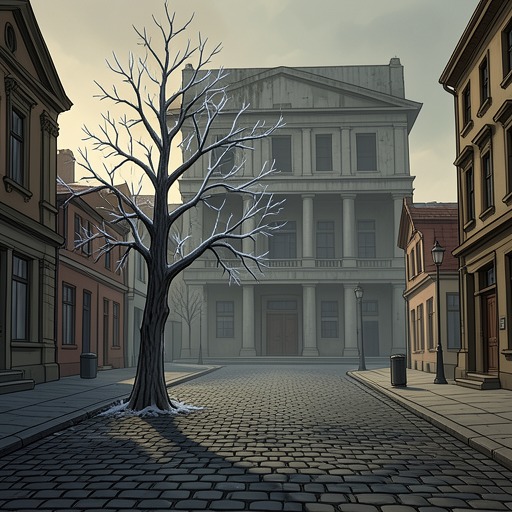
One for the Road
'Salem's Lot: A Novel“One for the Road” names a customary final drink before departure, but the phrase also becomes the governing irony of the embedded tale. At Tookey’s Bar, a routine farewell shared by Booth and Herb Tooklander is interrupted by a snowbound stranger whose arrival turns hospitality, travel, and survival into ominous uncertainties.
Meaning and Usage
The expression refers to having one last drink before setting out. Its familiar social meaning is established when Herb Tooklander is preparing to close the bar and offers Booth a final round. Tookey’s invitation, “Have one for the road, Booth,” is casual and practical: the drink marks the end of the evening and the expectation that Booth will soon leave.
The phrase therefore carries an ordinary ritual of departure. It belongs to the shared language of a bar, where a last drink can express companionship, generosity, or simple habit. In this scene, however, the reassuring custom is placed beside severe winter danger, so the words acquire a second, darker charge.
The Scene at Tookey’s Bar
The tale begins on January 10 during a powerful northeaster in Falmouth. Six inches of snow had fallen before dark, the storm was continuing heavily, and the radio forecast another foot of snow with winds reaching forty miles an hour. The side roads were already closed and were expected to remain impassable until the next morning, while Billy Larribee’s town plow was struggling merely to keep the main road open.
Against that setting, Tookey’s Bar is temporarily presented as a pocket of warmth and routine. Only Tookey and Booth are inside, listening to the wind around the eaves and watching it move the fire on the hearth. Tookey pours a drink for Booth and another for himself, making the expression a literal shared act rather than an abstract farewell.
The calm breaks when the door opens and a stranger staggers in. Snow covers his shoulders and hair, and the wind drives a fine sheet of it into the bar behind him. The stranger’s entrance makes the road in the expression suddenly present: whatever journey has brought him there has exposed him to the storm, and the bar’s final drink becomes entangled with the question of whether anyone can safely continue traveling.
Hospitality and Threat
Tookey responds first not with welcome but with an urgent command to close the door. The storm is not merely background weather; it presses physically into the room, threatening the fragile boundary between shelter and exposure. The stranger’s appearance—especially his fancy overcoat and white, staring face—also contrasts with the familiar, conversational atmosphere established by the toast.
This contrast gives the expression its narrative force. “One for the Road” begins as an everyday offer made between two men who know the rhythms of closing time, then becomes an ominous threshold phrase when an unknown traveler crosses into their refuge. The final drink suggests departure, while the blizzard makes departure perilous; the ordinary social ritual and the conditions of survival pull in opposite directions.
Narrative Function
The phrase works as a compact piece of foreshadowing. Before the stranger appears, it establishes a normal order governed by drinking, closing, weather reports, and local knowledge. Immediately afterward, the same setting is opened to uncertainty. The title thus connects the mundane world of a rural bar with the threatening world beyond its door without explaining the danger in advance.
Its effect also depends on narrative contrast. The story gives precise practical details about the storm—the snowfall, the closed side roads, the plow, and the forecast—before revealing the stranger. That realism makes the interruption more disturbing: the supernatural or unexplained threat, whatever its full nature, enters through circumstances that are concrete and recognizable. The expression becomes the verbal hinge between an ordinary night and a night in which the road may no longer be merely a road.